

As 2025 waned and Norman Maclean's, A River Runs Through It, neared the half-century mark since its publication, I got an email:
My name is Matt Foss and I am part of the team creating the world premiere opera for the Maclean family for the 50th anniversary of the ... novella.
An opera. I hadn't really considered that approach to the book's material. I pinged John Maclean (Norman's son) and he confirmed it was a go, and that it would be something that was perhaps unexpected. So, Matt and I talked, and it became apparent that this was different. Opera Montana was commissioning it and they wanted, well, a Montana opera.
When Matt asked if I wanted to be the fly-fishing consultant, my response was simple:
"Sign me up."

The Process
Since this project is current and on-going, I'm going to build this page like a "pseudo-blog," with updates as they happen. The premiere is at the Ellen Theater in Bozeman, Montana on September 18. I'll be in town and likely working right until the curtains go up (and maybe after). Over the summer, I'll be storyboarding, casting, shooting video, and choreographing.
Film vs Stage
One of the first discussions Matt and I had was concerning how to approach the stage from a fly-fishing perspective. As a filmmaker as well as a professor of theater, Matt was already ahead of me with my first thought: "Take whatever was done in the film, and do the opposite." Well, sort of.
In film, you can have multiple takes from multiple angles, as well as secondary filming units and footage pickups that can happen weeks or months later. You can stop the action to replace a malfunctioning or broken prop. And once you're in the editing process you can cut pieces together in an ideal way, even inserting clips from other scenes. That's a lot to work with! The stage has no such luxuries.
On stage, you get one shot. It's all live. It either works or it doesn't. If the "doesn't" is minor, it may go unnoticed or can possibly be skirted around by a quick-thinking actor. If the "doesn't" is major, it can disrupt the flow of the show—in real-time. Now take that reality, add fly rods, fly lines, and fly fishing and apply it to an opera where characters are singing, moving up and down stage and interacting with each other. Fortunately, Matt is a smart dude and already had the underpinnings of a solution: projection.
The stage design of the opera integrates a backwall screen for projecting images and video as enhancement to the stage action. That opens up more room for artistic interpretation and, after talking it through, solves some major sticking points with the fly-fishing scenes. Turns out that multiple cameras, plenty of takes, and dedicated editing are indeed a part of the production. This is where a motion designer comes in.
Motion Art & Stage Reality
Shooting fly casting in slow motion and projecting it is one thing, but in order for it to have a stronger artistic impact, there needs to be more. So, I first shoot the fly casting—focusing on the flow of fly line, not on me—for each character and scene. I am using a high-frame-rate camera, which ultimately allows for standard or slow-motion video when played back. I edit that raw footage into manageable sequences and those are re-interpreted by the opera's motion artist, Kristin Ellert. It's that last bit where the real magic happens.
No longer is the fly line simply projected realism. Rather, it becomes a reference point for departure into a kinematic representation of character and mood. It's not just existing in a background role, but is instead a dynamic enhancement to an actor's performance. It also solves a difficult issue.
The challenge of characters fly casting/fishing on a relatively small stage while moving and singing in real-time is not something to approach casually. I have done plenty of fly casting on stages over the years, and I know the pitfalls that are possible. I even hooked an Allosaurus (long dead) on a backcast one time, but that's another story.
Casting Without Lines
No cast member wants to be without their lines, but in the case of certain fly-fishing scenes, lines may not be present—fly lines, that is. The current direction is to have the cast (meaning the two brothers) perform certain scenes using only fly rods, with the projection taking over as the focus of the fly casting. Stage fly lines are set to appear at other times, though (more about the lines below).
Going line-less at certain times should allow the actors to focus and move more easily, even though they will still be holding stage fly rods and dealing with other props. In turn, this should reduce the time needed for scene prep and lower the practice bar required to make the fly-casting function live and in-person.
Gearing Up — Stage Rods
As I work through shooting the fly casting to be used for projection, I am also acquiring props (gear) to used on-stage. That includes rods, reels, lines, and flies. Gearing up for stage, though, is not the same as gearing up for film.
Headwaters Bamboo is providing the opera with modern bamboo rods. Given the stage dimensions and stage line weight, we are using the small-stream Grande Ronde model, built with the Dickerson 6611 taper. These rods are six feet, six inches and rated for a three-weight line. But didn't the Maclean boys fish big-river rods? Yes, they did, but they also didn't cast on a stage that's 21 to 26 feet wide with vertical clearance ranging from 12-15 feet.
Using modern, batch-built bamboo rods offers the production four key advantages: Cost (gratis, in this case), period-esqe appearance, consistency of build from rod to rod, and rapid replaceability if needed.
Gearing Up — Stage Reels
Norman is spinning a Pflueger 1494, a reel he fished in real life. Cost, coupled with the relative scarcity of clean, 1930's examples kept us away from vintage 1494s. Instead, we went with mid-century production. The later reels have the classic, highly recognizable 1494 look, but are more readily available, are frequently clean in appearance, and can be had for modest sums.
Paul is cranking a Shakespeare Russell 1895. It's a period-correct design, with Paul's primary stage reel being from the River Runs era (his back-up reel is dated post-War). The 1895 is a utilitarian fly reel with enough capacity to handle the 10-pound rainbows everybody was always catching back in the day (weren't they?). As an inside joke, the 1895 is bigger than Norman's Pflueger 1494, hinting that Paul tends to catch bigger fish.
Gearing Up — Stage Lines
Stage lines have to be balcony-level visible, easily castable, and not look like 20-foot-long cat toys. We tried plenty of existing lines and yarn-shop materials, but it all tended toward "not visible enough," "not castable enough," or "where did these cats come from?"
We finally arrived at a paracord-based "fly line" with a trimmed furled leader at the end. The lines satisfy the needs of the stage and have a subtle, distinct casting sound. There may still be an occasional cat hanging around, though.
Remember that this isn't film, it's stage, and the requirements are markedly different. The lines are suggestive of silk, while also allowing the audience to follow along visually. And of course, there will be projected fly casting to add a whole lot more.
Gearing Up — Stage Flies & Fly Boxes
The stage flies for the show are the ones that reside on hats or in fly boxes and get "tied on" during brotherly exchanges on the river. Those who are familiar with River Runs history know the names Norman Means (Bunyan Bug) and George Croonenberghs (quill-bodied Generals). Employing vintage Bunyan Bugs and Generals isn't the wisest use of historical flies, nor of the opera's props budget. So, there are stunt flies.
First, we have a small number of modern Bunyan Bugs, tied by long-time family friend, John Beth. He uses them for bass fishing and I can attest that they work! George's "stunt" Generals are tied by my father (I was going to do the tying, but he volunteered!). He didn't tie them to be exact replicas, he tied them to mimic silhouette and to have some visual "pop" while perched in a hat band.
Along with the flies come fly boxes, especally for Norman. Like much of the other gear, Norman's primary fly box is "period-looking" and not period-exact. It's a Charles F. Orvis (yes, that Orvis) magnetic box that will make it easy for Schyler (who plays Norman) to remove a Bunyan Bug on-stage. The magnets prevent the fly from moving around in the box, or worse yet, accidentally dropping to the stage floor when the box is opened.
I also snagged an old-ish, magnetic Perrine #69 fly box as a back-up/second box for use wherever. It looks vintage and cool, and it can hold any fly we want. Sometimes that's all you need.
Fly Casting — Video for Projection
The video acquisition of fly casting for projection is moving closer to done, with a big thanks to Joseph Hunt Design. Joseph shoots cool stuff, like rally cars and tuner Porsches. He also shoots boring stuff, like some dude standing in front of a warehouse while fly casting on asphalt.
We'll probably be doing little bits of video work until we hit the drop-dead date and then that's that. Hopefully, we'll get everything we need to make the projected fly casting the best dynamic enhancement it can be.
Fly Casting — Creating Stage Moves
The score and the libretto for the opera are in the final stretch, and with that comes the need to synchronize the on-stage fly casting. While Matt is directing the overall action, it's in my court to tweak the actual casting itself. I even bought a fancy new metronome so that I could match required musical BPM to the casts.
I'm shooting quick-and-dirty video in my driveway, and then Matt is adjusting the action to match the flow on-stage. As we get that melded, Schyler and Michael (Norman and Paul) are getting video clips on which to base their individual stage moves.
A Week at the Ellen
As of September 11, I'm in Bozeman and into the rehearsal process at the Ellen. For me, it's all about fine-tuning anything and everything fly-fishing related, from props to casting. I'll have updates until go time.
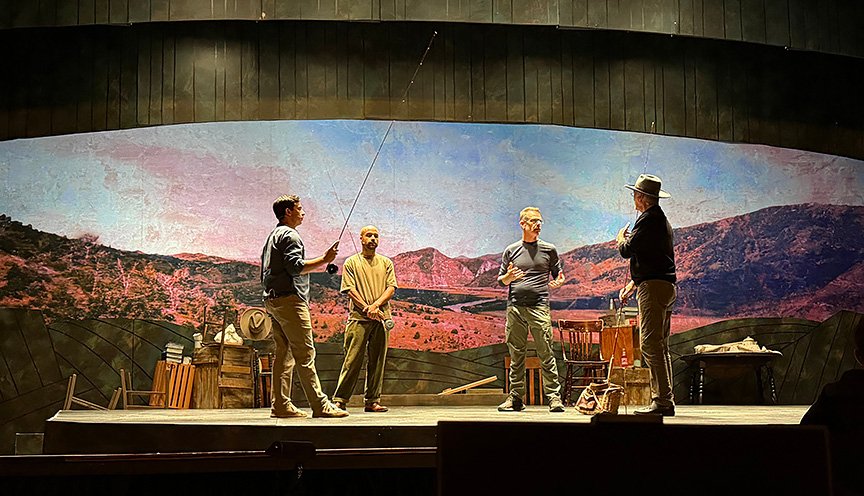
Fishing rehearsal (l to r): Schyler, Michael, me, David (Reverend Maclean). Production photo by Matt Foss.
Fly Lines Are Out!
That didn't take long. Small stage, lots of movement, multiple actors = fly line chaos. Pantomime and projection are making it work! They were cool lines, though.
Fly Casting is Set
As of Saturday afternoon (Sept 12th), the fly casting and fishing moves are set. We will be refining over the next several days.
Schyler (Norman) has arrived at the form he needs for his character: competent, not fancy, with some small personal influences on grip and arm position.
Michael (Paul) has the most challenging fly casting/fishing scenes. The big moment—the Shadow Cast—took its final form during rehearsal on Saturday afternoon. Michael is able to lean on his physcial performance background to give him a better sense of flow in the fine-tuning process.
David (Reverend) wasn't originally supposed to cast at all. But that changed, and he does now make two "memory casts" where, in his older age, he envisions his river time as he holds his fly rod. An accurate range of motion is there, but it's softened by visions of days long past. David is a fly fisher in his non-acting life, so to allow his character even a few seconds of casting time has been great for both of us.
Part of the challenge is that the fly casting and fishing within the opera aren't always supposed to be technical and precise. Casting and fishing skills are there, yes, but they often flow outside practical fishing boundaries and blend with story, mood, voice, and music. That's a deliberate part of the experience and audiences should not expect a film-like reality.
On the Gallatin (Fly Casting IRL)
This morning (the 14th) was spent with Schyler, Michael and Matt on the Gallatin River at Axtell Bridge. Chet Layman from KBZK was filming for local news. It was possibly our last on-the-water casting before go time. It was also breezy and chilly, but Montana fall beautiful! There is no doubt that it was time well spent. Both actors jumped forward in their casting/line-handling skills and that's going to make a real difference come Friday.
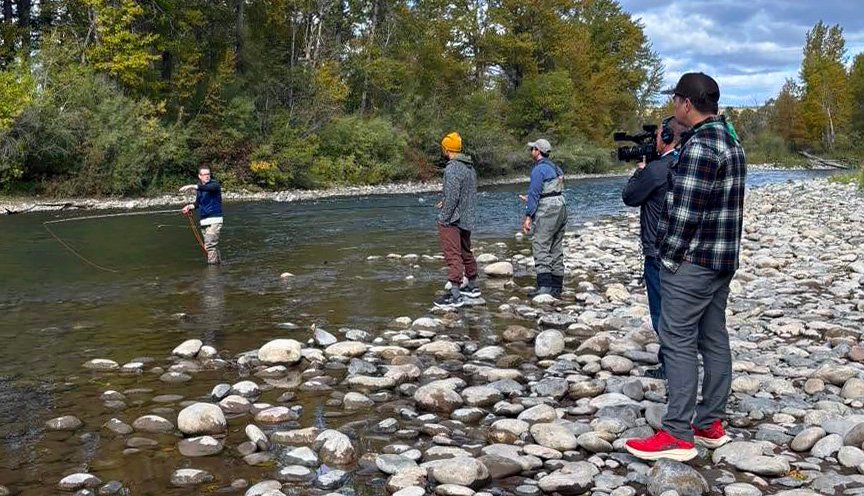
On the Gallatin at Axtell. (l to r) me, Michael (Paul), Schyler (Norman), Chet (camera), Matt. Photo by Opera Montana.
Final Rehearsal!
This is it. Wednesday evening, final time on stage before Friday's premiere. Orchestra is warming up, as are the actors. Fly fishing props are on stage and projection is showing a stylized Blackfoot River. Photographers are setting up positions and seats are filling.
A lot has happened since Matt and I first talked. A lot has happened in the last week. The fly fishing has been trimmed to fit, with lines and flies both having to stay in their respective boxes. Perhaps for another day.
Five minutes to curtain, laptop away, here we go.
Update: Beautiful rehearsal, the show got great applause, and the afterparty felt perfect. Now for Friday.
All Things Merge Into One
So here we are, September 18, the day of the premiere. I'll update once the show is over, and I truly hope that those in the audience will leave saying, "It was beautiful."
Update: What a show! Full house (420 seats), artistic stage, moving libretto and orchestration, outstanding performances. Even the fly casting/fishing worked as planned.
A sincere thank you to all who attended, including John Maclean, who has a Montana-strong bear-hug!
Loved the afterparty at Brigade. So good to see everyone there and catch up with a few people I had not seen since the other production of River a mere 35 years ago. That includes Noah Snyder, Norman's grandson, who was a teenager the last time we met (and I was barely more than that myself).
May this show get legs and run!
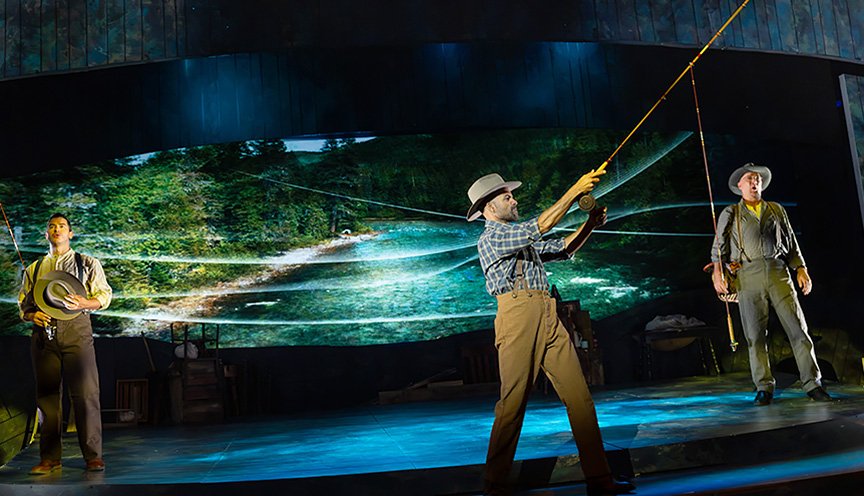
Paul shadow casts as Norman (l) and the Reverend (r) look on. Production photo by Nile Scott Studios. Instagram: @nilescottstudios
Postscript
The reviews are in after the Bozeman premiere and River is a critical success, in addition to being a hit with audiences. The New York Times, The Wall Street Journal, and The Washington Post all published reviews and/or stories about the opera.
PBS Montana is recording the last several Bozeman shows to add to their schedule in 2027. That should give anyone anywhere an opportunity to view the opera. It is my hope, of course, that the show will run live at other venues in the future. It is worth seeing in-person.
A heartfelt "thank you" to the production team for inviting me to be a part of the show. It was a pleasure to get to know you all and to assist in this telling of the Maclean family story. And, a thank you to the actors. You made me feel immediately welcome on-stage. For those who had to deal with fly fishing, you honored your roles by deep diving as far as necessary—it certainly showed on opening night.
Here's a "Toi, toi, toi!" to future productions.
"The Blackfoot" painting by Clyde Aspevig for the opera, A River Runs Through It (via Opera Montana).